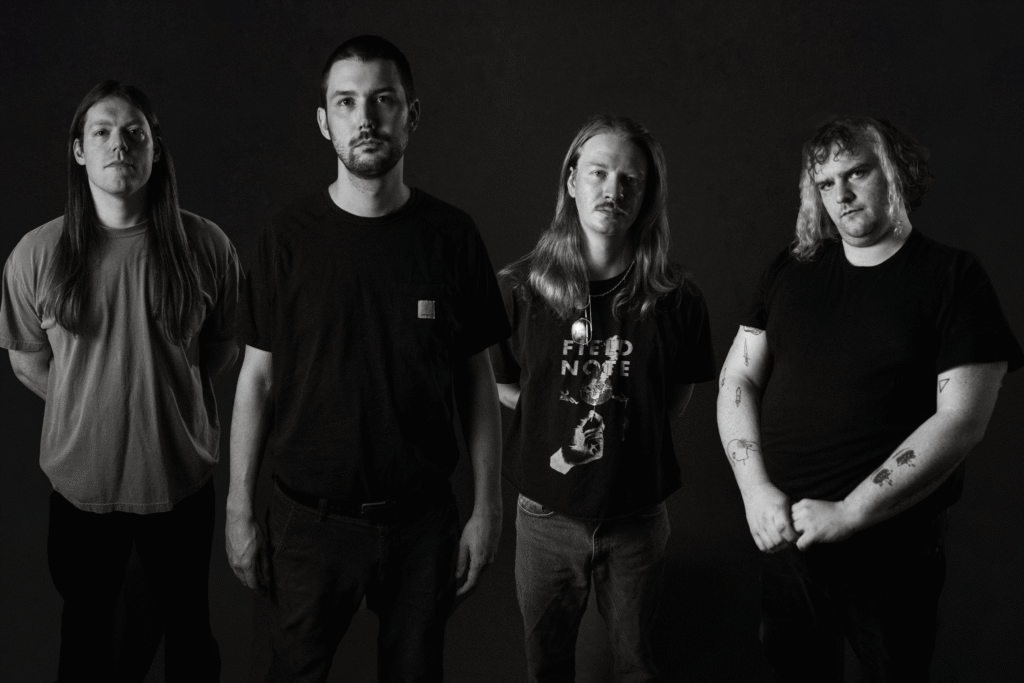

Punk and hardcore have long been a safe haven for those who don’t fit in, but what do you do when you still feel alone amongst the outsiders? Beneath The Wheel, the sophomore full-length from Gumm, tries to answer that question with 26 minutes of the most ferociously free-sounding music you’ll hear this year.
Since their formation in 2018, the Chattanooga, TN-based group–vocalist Draw Waldon, bassist Philip Amos, drummer Harrison Battles, and guitarists Dylan Mikres and Trevor Lynch–have been making a name for themselves with a potent blend of hardcore that’s equal parts eye-bulging aggression and far-reaching sonic imagination. Now Beneath The Wheel, the follow-up to Gumm’s debut album Slogan Machine, amplifies both the feral bite and the surprising tunefulness in their sound. Recorded by Tate Mercer (Dying Wish, Chamber), the album somehow further defines the band’s sonic identity while also expanding it. “It feels like we’ve finally reached what we’ve been going for,” says Waldon. “Our influences or references are becoming harder and harder to pin down, just because we’re a highly collaborative band and we all listen to so much different music. We’re all bringing something different to the table, and I don’t even think it’s that intentional–we’re all just making hardcore together but where our individual lenses come together is where the sound of Gumm lands.”
That sound is better than ever on Beneath The Wheel: an unhinged amalgam of cutting guitars, churning bass, primal drumming, and Waldon’s dynamic roar. While musically Gumm is a hyper-tight unit, lyrically Waldon is preoccupied by an existential loneliness. “It’s a much more inward-looking and personal record than Slogan Machine,” he explains. “I think a lot of the lyrics on the record deal with isolation and alienation, with a focus on self-work and self-preservation.” Beneath The Wheel opens with the title track, which grabs the listener by the head and demands their attention. The song’s midtempo stomp suddenly kicks into a gallop as Waldon’s strained voice rings out, sounding at war with the world and himself simultaneously. The album then launches into “New From The Pain,” where Waldon delves deeper into Beneath The Wheel’s recurring themes. “Not fitting in, not being truly connected or comfortable in most settings, not connecting with love in a real meaningful way–these things have manifested this constant, dull, mundane pain that just lives in me,” he says. “Then those feelings lead me to isolate and bury parts of myself. Only recently have I tried to actually face these things and build something new out of them. I don’t want to be defined by feelings of isolation, I want to use the pain to make myself stronger and more open and vulnerable.”
Waldon’s self-reflection continues on tracks like “One Thing At A Time” or “Need,” which unfold around tightly wound post-hardcore riffs and near-meditative lyrical refrains. “Those songs are full of reminders I need to constantly give myself,” he says. “They’re about trying to re-center and remain present in life. It’s difficult to maintain that mindset with the constant rush and noise of the world all around at all times.” On “All Gone,” the band pinwheels between gritted teeth rage and downright anthemic choruses powered by handclaps and cowbell, all while Waldon looks back at past selves in an effort to better the person he is today. “The song deals with losing oneself in attempts to fit in and be a part of a group. It’s more or less a question of identity–and a mourning for my younger self who always felt the need to fit in.”
Mid-album standout “Learn Nothing” captures the defiance at the heart of Beneath The Wheel, a refusal to accept the hand you’ve been dealt and instead make something better out of it. “It’s an expression of living with a mental chemistry that seems to be self-destructive, and how I have to rise above that daily,” Waldon explains. The song pounds forward like a careening train, all unstoppable momentum and the determination to harness negative feelings into something else–maybe not something positive, but at the very least useful. “It’s about the idea that really digging and uprooting your self-sabotaging impulse sometimes requires much more than just love and support,” he says. “It requires blood and sweat and tears. There’s hard work to be done.” Thankfully Gumm are up for the job.